

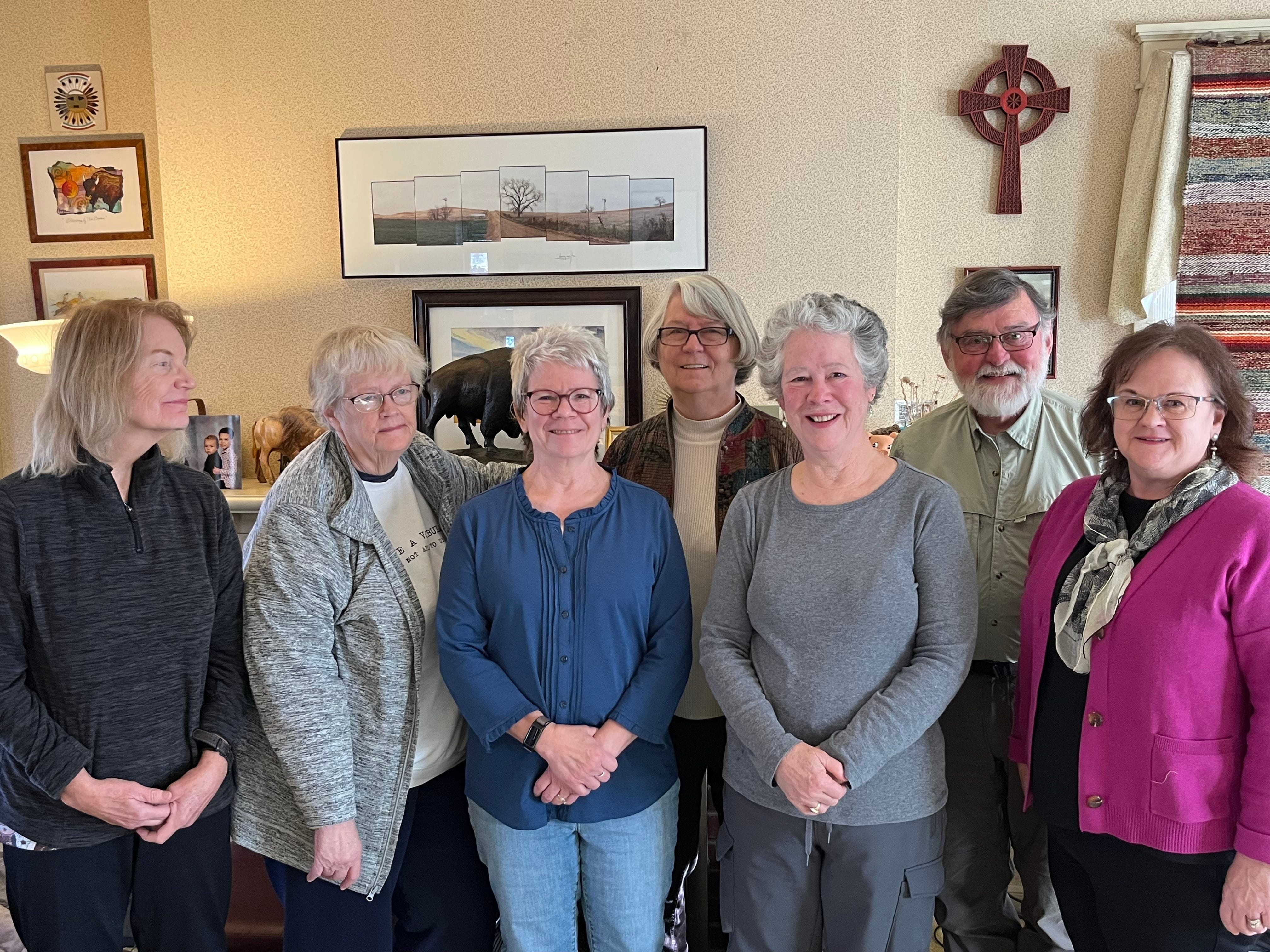
Last Friday, I gave the message at the funeral of Edie Snethen, the leader of the Spiritual Formation Group I had attended either in person or online for at least an hour and a half once a week all year around for twenty-two years.
There were six or seven of us most of the time. The people who participated changed from time to time with a core of three of us remaining pretty much from the beginning. Initially all were members of the church (Lutheran) of which I was the Senior Pastor (although I participated in the group as a member, a peer). I continued to attend after I retired. As time went by, people from other traditions participated, and many in the group, whatever their current church membership, had been raised in other traditions or no tradition.
Edie’s (and my) intention was to have a place to talk openly about the personal and relational dimension of the message we heard in our religious traditions. The goal was not an academic one, to study the Bible or church doctrines. The goal was to bring the message into our daily lives, the ones we were actually living in all their complexity. She had trained at Souljourners, an ecumenical program connected to the Benedictine tradition, that studied contemplative spirituality. I had already incorporated into my personal life a contemplative dimension from early in the 1970s, so we came to the group with the same goals.
Each session began with a time of silence after we had greeted one another. The guidelines were very basic: listen to one another without judgment, don’t interrupt, and honor confidentiality (what happens in Vegas, stays in Vegas). We always had something that could be read in one sitting, each member reading a paragraph or two, stopping often to process together what had just been read. We often joked that it didn’t make much difference what was being read, since we could create an interesting discussion from almost anything.
The one constant was trying to answer the question:
What difference does this make in our day to day living?
How does this express the Presence of God in our lives?
This was a place in which we could ask ourselves hard questions. We could express doubts openly. We looked at various religious traditions, but not as an intellectual exercise. We could challenge our own traditions without fear. On three different occasions in the twenty-two years, we used the same book on creating a Spiritual Autobiography. The basic task was to review our growing up years through our current time in life, looking for specific ways our spiritual lives were affected by events. Edie always shared that she learned contemplation from Tizzie the cow, looking into her eyes as she chewed her cud. I shared my time playing in the swamp as a child. There were different people in the group each time we did the Spiritual Autobiography, but those of us who were doing it again always made new discoveries.
We discovered that the contemplatives in differing world religions used the same language. It was not a threat to our tradition to talk about and learn from others. Even the language of Mindfulness that might not include any reference to a supernatural being was often the same as that of the Christian Contemplatives or the Contemplatives of other religious traditions. Edie was an avid reader of books on brain science and the impact of contemplation and mindfulness of the physiology of the brain. Scientific study is not the enemy but a way to understand the connection between our physical bodies and the spiritual dimension of our existence.
My experience, since I retired and am no longer primarily focused on nurturing other people’s religious/spiritual lives, has been to focus on my own journey. I discovered early in my career that dividing reality into Sacred and Secular makes no religious sense if God is the Source of the Universe in which we live. There aren’t two realities, Sacred and Secular. There is only one reality, we are simply looking at it through different filters, different lenses.
If what we believe is true, it is not only true using the language of a particular religious tradition.
That expands dramatically the Wonder in living. Every new discovery, as we study the Universe in which we live, increases the magnitude of God for those who believe in God, and the magnificence of our existence for those who don’t include that belief in their understanding of reality.
There is a central dynamic for living that comes with my religious tradition and most other religious traditions. At almost every meeting of our Spiritual Formation Group, Edie repeated a short Biblical reference, God is Love. While the institutions claiming to be of God, sometimes act in unloving and even hateful ways, love is a centerpiece in what most of them teach. Scientific study of the Universe both at the Newtonian and Quantum level recognizes that everything is intertwined, and in that regard, relational. Using a simplistic view, we are connected to the world we live in and to everyone who lives in it. What each of us does affects the rest of us. Whether it is the people or the planet on which we happen to live, the dynamic that holds us together is love. It is the recognition that, like it or not, we belong to one another. Everything we say or do that benefits other people and the planet we share ultimately benefits us.
The way our Spiritual Formation group expressed that dynamic through the years, provided me a secure and nurturing space to deal with the challenges in my life, especially the loss of my wife of forty-five years, Mary Ann. During the most difficult years, the congregation I served put the dynamic of love into action. I will be forever grateful.
The Destination is Now,
Peter
It took a while to find my way to this place in my worldview. I always had a scientific bent and for before and during my career I thrived in a flawed but nurturing, at least for a white male, experience with Christianity. I am happy where I am now, thrilled with the wonders of the natural world, intrigued by what lies at the edge of discovery in the world of Quantum Physics, and enjoying the relationships that were built in religious communities and as well as the ones that have emerged in my travels.
I really appreciated this post and the way you described how one might experience the vast and illuminating beauty of this world through a secular and also non-secular lens. It feels rare for acknowledgement of both. Thank you.